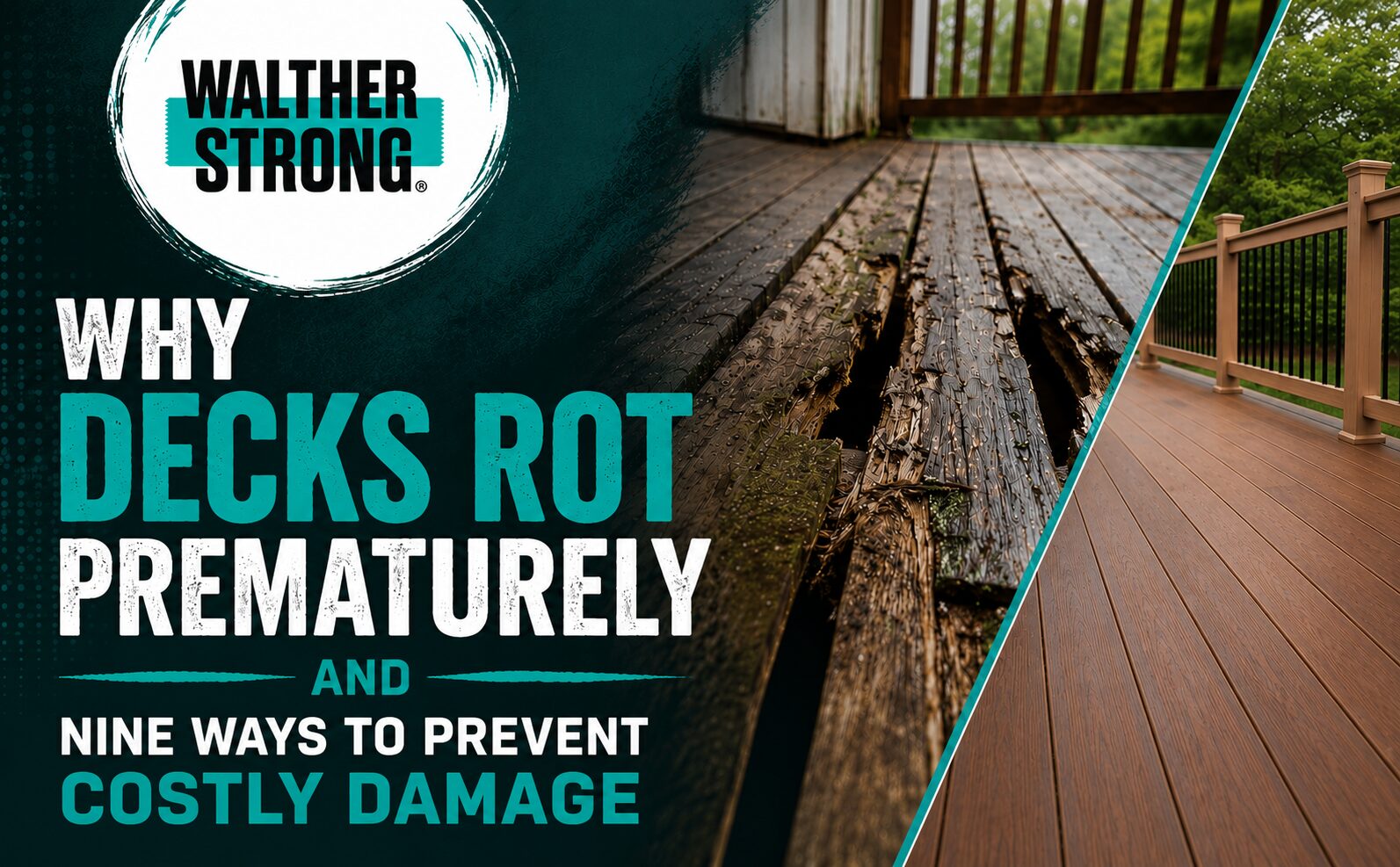
Why Decks Rot Prematurely
Unchecked moisture, poor ventilation, and lack of routine maintenance are the main reasons why your deck might start rotting way before it should. Here’s a short list of reasons you should keep in mind:
1. Trapped Moisture
If water pools in wooden surfaces or sits in piles of wet leaves and debris, it enters tight gaps between boards and gradually penetrates the wood and causes rot to develop.
2. Unprotected End-Grain
If end-grain is not sealed during installation correctly, its highly porous surface absorbs water like a sponge and rot quickly travels up the board.
3. Improper Flashing
Water can track behind the ledger board and rot both the deck support and the house’s exterior wall.
4. Wood-on-Wood Contact
Where two structural pieces of wood touch, such as joists resting on beams, capillary action pulls and traps water between them, which leads to rot.
5. Poor Airflow
If the deck is built close to the ground, it may lack the needed ventilation to let the soil and the underside of the deck framing dry out, which may lead to premature rot.
9 Deck Rot Prevention Tips That Guard Against Costly Damage
It is critical to apply deck rot prevention techniques to safeguard your deck from the damp and unpredictable UK climate. Here’s a list of nine such techniques that will help prevent rot:
1. Protect Joists Before Boards Go Down
Most deck rot does not begin on the visible surface. It starts on the top edge of joists, where water becomes trapped beneath deck boards. Applying a self-sealing deck joist tape during installation will create a waterproof barrier over the framing and block moisture from entering. It also prevents moisture from getting through screw penetrations – one of the most common points of long-term timber failure.
2. Use Breathable, Water-Repellent Sealers
You should avoid cheap, low-quality varnishes that form a plastic-like film over the wood. Why? These coatings crack over time, which will trap rainwater underneath and accelerate rot. So, instead, you can use a highly breathable exterior wood waterproofer or premium deck oil that chemically bonds with the wood pores. It will allow internal moisture to escape, but won’t let rainwater seep in.
3. Coat Cut Ends with End-Grain Protector
Whenever you saw or drill a timber board, you expose the porous inner rings of the wood, and it soaks up water like a sponge. So, it is always wise to apply a dedicated end-grain protector, like our HD Timber Coating, to every fresh cut. Apply the product before you permanently screw the board down into place.
4. Maintain a 150mm Airflow Sub-Structure Gap
You should never build a timber deck flush against the damp soil or grass. In the UK, you need to create a cross-breeze that dries out the ground. You do that by leaving at least a 150mm ventilation gap beneath the deck frame. It prevents moisture from rising into the joists.
5. Clear Wet Autumn Leaves Promptly
If you don’t clear fallen leaves from the autumn months, it will trap a thick layer of moisture directly on the wood surface and starve it of oxygen. A build-up of leaves creates the perfect incubator for wood-decay fungi and slippery algae. You should use a stiff broom to regularly sweep away wet leaves and organic matter.
6. Create Consistent Board Gaps (4mm to 6mm)
When fixing your decking boards, you need to ensure that you leave a consistent gap of 4mm to 6mm between them. This gap allows rainwater to fall through efficiently. This way, you prevent rainwater from pooling on top. It also makes sure that trapped twigs, pine needles, or dirt are easily cleared out.
7. Avoid High-Pressure Power Washing
It may be tempting to blast away winter grime with a power washer, but don’t. Using a pressure setting that is too high will strip away the wood’s natural defensive oils and tear the wood fibers apart. This makes the timber significantly more porous and prone to rot. You can use a specialised decking cleaner instead. You can mix it with warm water and scrub with a soft-bristle brush.
8. Kill Off Algae and Mould Early
Green algae and black mould thrive in the UK’s damp climate. It is especially so in shaded and north-facing garden spaces. If patches appear, do not wait. Treat them with a natural white vinegar solution or a non-bleach fungicidal wash to eradicate fungal spores before they root deeply into the wood structure and help spread rot.
9. Upgrade to Stainless Steel or Coated Fasteners
In wet conditions, cheap screws corrode rapidly and react chemically with the wood treatment. This weakens the timber fibres around the screw holes. So, you should use high-quality stainless steel or green-coated exterior deck screws because they resist corrosion and help protect structural connection points.
Why Choose Walther Strong for Your Deck Tapes?
Deck rot prevention should start long before surface damage becomes visible.
Why? Because moisture often enters through hidden areas such as joist tops, screw penetrations, cut ends, and connection points. So, long-term deck protection totally depends on how well these components as well as the deck joist are protected from moisture.
Walther Strong Deck Tapes are designed specifically for this purpose. We use a high-performance polymer acrylic adhesive rather than traditional butyl technology. It creates a waterproof and weatherproof barrier that protects timber and composite deck frames from moisture ingress, rot, and premature decay.
Walther Strong Deck Tape Is Engineered to Protect the Most Vulnerable Areas
Unlike surface coatings that gradually wear away, our Deck Tapes bond directly to the timber and self-seal around fixings, which are one of the most common entry points for moisture. They can also be overlapped without affecting board stability or deck height.
Recommended protection areas include:
- Joist tops beneath deck boards
- Joist hangers and connection points
- Freshly cut timber ends
- Around fixings and fastener penetrations
These Are Built for Long-Term Performance
We have tested our Deck Tapes across all decking systems and timber treatments to ensure they are suitable for both traditional timber and composite decking installations.
Key performance benefits include:
- 25-year bond guarantee
- Waterproof and weatherproof protection
- UV-stable non-butyl construction
- Performance from -40°C to +93°C without cracking or peeling
- Compatible with treated timber once fully dry
- Manufactured using upgraded sustainable materials with recycled thermopolymer reinforcement
Walther Strong Deck Tapes are trusted by installers across the UK and internationally. They have become a professional choice for extending deck subframe life and helping prevent avoidable structural deterioration. If you have any queries or questions regarding this product, do contact Walther Strong at 01780 437222 or write to enquiries@waltherstrongandco.com.